What is the Shroud of Turin?
The Shroud of Turin is a blood-stained cloth bearing the image of a crucified man. It is believed by some to be the actual linen burial cloth that wrapped the body of Jesus Christ after His Crucifixion, a practice common among the 1st-century Jewish people. Its name is derived from its longtime home in Turin, Italy, where it has been since 1578.
There has been such extensive interest in the Shroud that there is a name for the formal study of it: sindonology. It is considered to be the most studied artifact in the world, with more than 100 different disciplines closely examining it. The original shroud — kept in a state of careful preservation and not currently on display — has been in the formal possession of the Holy See since 1983. Its history prior to 1354 is not well-documented.
It is important to note that the Catholic Church has not taken an official position on the Shroud of Turin’s authenticity, but recognizes its importance as an object of veneration and reflection. The church acknowledges the ongoing scientific investigation into the Shroud’s origins and properties, entrusting scientists with the task of finding satisfactory answers to questions surrounding it. Popes have consistently recognized the Shroud’s significance as a powerful image that points to the Passion and death of Jesus, inviting believers to deeper contemplation and conversion.
Shroud Facts: Did You Know?
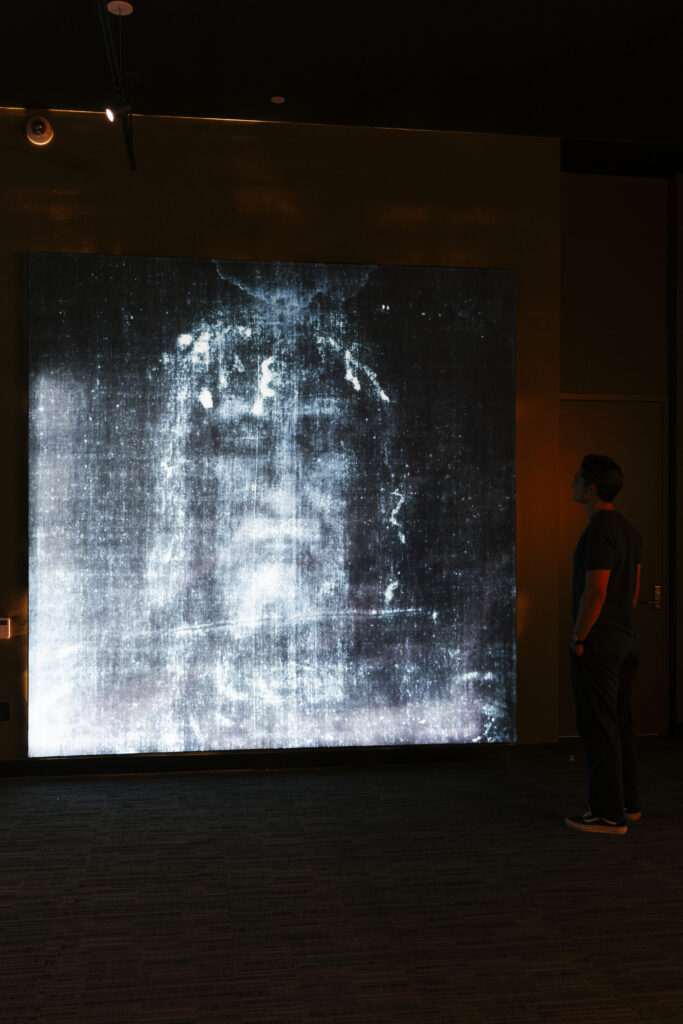
- The Shroud of Turin is the most scientifically studied single object in the world, subjected to close examination by more than 100 different disciplines. It is approximately 14 feet long and 4 feet wide.
- Out of thousands of historically preserved burial linens, the Shroud of Turin is the only one to feature an image of a body.
- The influential STURP (Shroud of Turin Research Project) group in 1978 spent five days examining the actual Shroud, working in 24-hour shifts. They determined that it is not the product of an artist and contains no pigments, paints, dyes or stains. They concluded it had direct contact with a scourged, crucified body, but could not explain the high-resolution image of the face.
- Despite numerous attempts, no one has ever perfectly duplicated all the unique characteristics of the Shroud. It would require a detailed, anatomically perfect three-dimensional image that looks like a photographic negative, made without painting, drawing, rubbing or photography. It would also demand coloration of the fibers less than half the width of a human hair.