This experience is appropriate for older children, age 10 and above, at parental discretion. The Shroud of Turin bears evidence of the crucifixion, burial and resurrection of Jesus; some children may be sensitive to this information.
Children ages 10 to 14 should be accompanied by an adult. Children under 10 are welcome at their adult guardian’s discretion. Children who require a seat must buy a youth ticket. Children sitting in an adult’s lap do not require a ticket.
Thank you for understanding our desire to present the Shroud of Turin to an appropriate audience.
Our general policy is no refunds. However:
- If we cancel your event, a full refund will be issued within 30 calendar days of the cancellation.
- If we postpone or reschedule you to another time slot, a full refund will be issued to the ticket holder upon request (within 30 calendar days of the request.)
- For extenuating circumstances, please contact our event manager at least 24 hours in advance of your ticket time.
Yes! Send us a request for information at Group Sales. If your group is larger than 26 people, we would need to accommodate you with separate and subsequent timed entries. Please contact our Guest Services for assistance.
The three theaters are currently only offered in English. The museum portion has QR codes for translated text in Spanish and Vietnamese. For organized groups of 26+, we can provide multi-lingual docents upon request for the museum portion.
Yes! We have dedicated parking in the Shroud of Turin Lot (P7) adjacent to the Richard H. Pickup Cultural Center, where the Shroud Experience is located. There is an elevator at the entrance that will take you to the 2nd floor where you will find the museum. (Please note the entrance is on the western side and not on the plaza side.) Please inquire in advance if any other accommodations are needed.
We welcome school groups! Please see Group Tickets for reservations and access to our special curriculum designed for schools and religious education programs.
The Shroud of Turin is a blood-stained cloth bearing the image of a crucified man. It is believed by some to be the actual linen burial cloth that wrapped the body of Jesus Christ after His Crucifixion, a practice common among the 1st-century Jewish people. Its name is derived from its longtime home in Turin, Italy, where it has been since 1578.
There has been such extensive interest in the Shroud that there is a name for the formal study of it: sindonology. It is considered to be the most studied artifact in the world, with more than 100 different disciplines closely examining it. The original shroud — kept in a state of careful preservation and not currently on display — has been in the formal possession of the Holy See since 1983. Its history prior to 1354 is not well-documented.
It is important to note that the Catholic Church has not taken an official position on the Shroud of Turin’s authenticity, but recognizes its importance as an object of veneration and reflection. The church acknowledges the ongoing scientific investigation into the Shroud’s origins and properties, entrusting scientists with the task of finding satisfactory answers to questions surrounding it. Popes have consistently recognized the Shroud’s significance as a powerful image that points to the Passion and death of Jesus, inviting believers to deeper contemplation and conversion.
Papaian Studios is a newly formed media company dedicated to creating and supporting projects that illuminate faith, inspire hope, and positively impact culture. Rooted in the belief that media can be a powerful instrument for good, the studio seeks to advance the Gospel and uplift culture through innovative, creative, and nostalgic storytelling.
Papaian Studios’ inaugural project is “The Shroud of Turin: An Immersive Experience,” which exemplifies its mission: a partnership that unites faith, art, and innovation in service to Christ.
Othonia Inc. is a part of the Institute of Science & Faith of the Pontifical Athenaeum Regina Apostolorum in Rome. Othonia’s name is derived from the Greek word used in John’s Gospel for the “burial cloths” that Peter and John found in the “empty tomb” on that first Easter morning.
The mission of Othonia is to encourage people to examine the Shroud through the eyes of both reason and faith. Through its educational materials, exhibits and speakers, Othonia invites people to answer for themselves the question that Jesus asked His followers: “Who do you say that I am?” The Shroud belongs to the undivided Church and provides an opportunity for restoring unity within the broken Body of Christ. The Shroud promotes dialogue around its unsolved mysteries and is a wonderful tool to reach those who don’t know Jesus or who have fallen away from their faith.
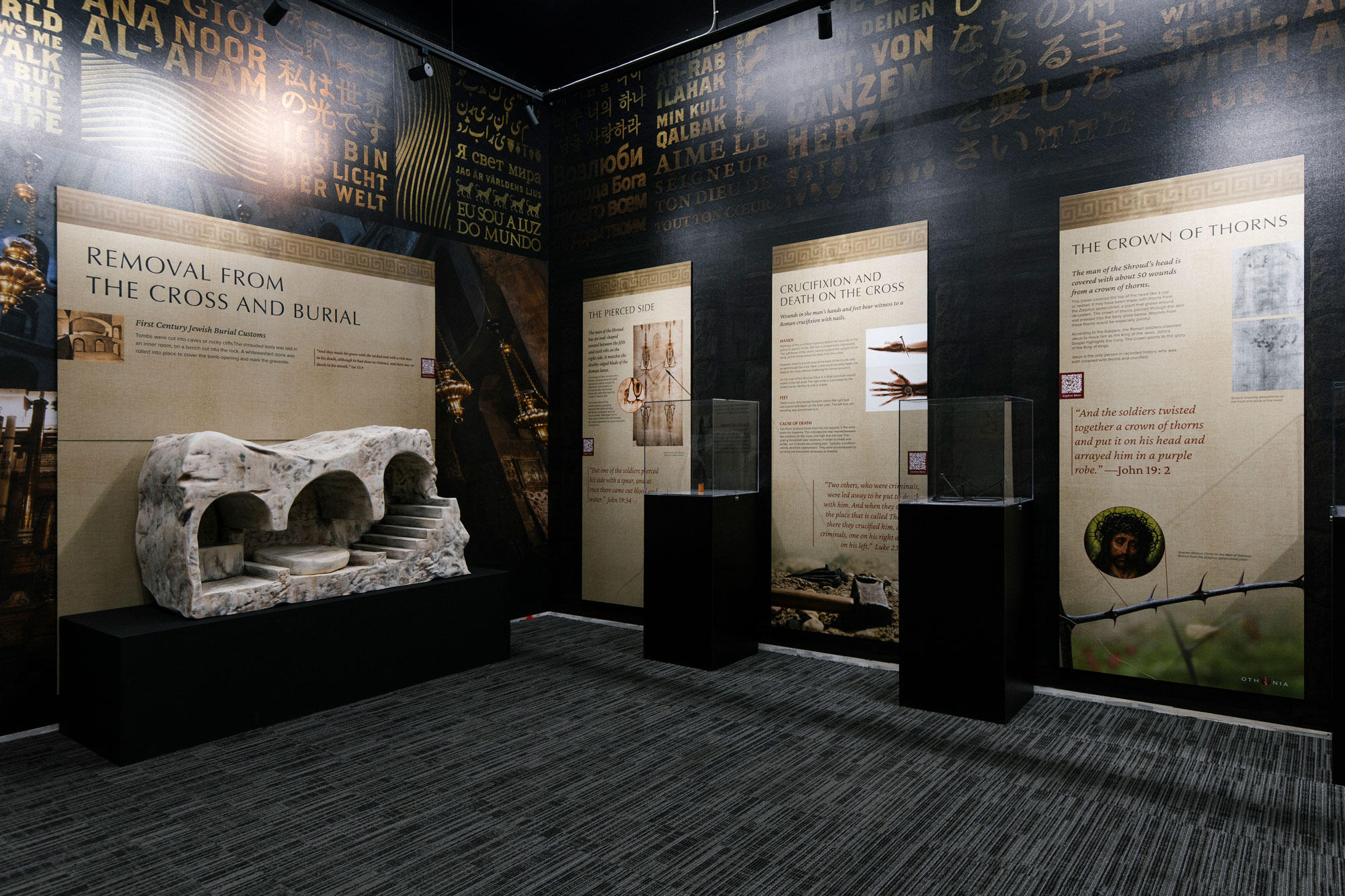
Othonia’s flagship museum, “The Shroud of Turin: An Immersive Experience” in Orange County, offers a fascinating journey into the history, science and spiritual significance of this artifact, blending Shroud research with compelling storytelling to inspire wonder, unity and a deeper relationship with the man of the Shroud. For more information, visit Othonia.org.
It is our museum’s position, based on available evidence, that the Shroud of Turin is not a medieval forgery. Despite hundreds of thousands of research hours across multiple disciplines, no one has been able to explain how the image was made on the cloth. There are numerous news articles citing various theories; however, these oftentimes don’t take into account the full realm of scientific research that has been done on the Shroud for decades. Before dismissing its authenticity, we invite guests to come see what has been discovered about the Shroud that can’t be explained by any simple hoax theory.
The 1988 carbon dating of the Shroud of Turin — long cited as proof that it’s a medieval forgery — is now widely questioned due to sampling flaws, with new evidence suggesting the cloth may be much older than originally thought.
Despite numerous attempts, no one has ever perfectly duplicated all the unique characteristics of the Shroud of Turin. One would have to create a detailed, anatomically perfect three-dimensional image that looks like a photographic negative, and do it without painting, drawing, rubbing or photography. You would also have to make the coloration of the fibers less than half the width of a human hair.
Elements of blood and, consequently, DNA have been found. However, the blood is so old that very few DNA fragments have been found. In addition, it has been handled so many times over the centuries that DNA from numerous sources have been left on the linen cloth.